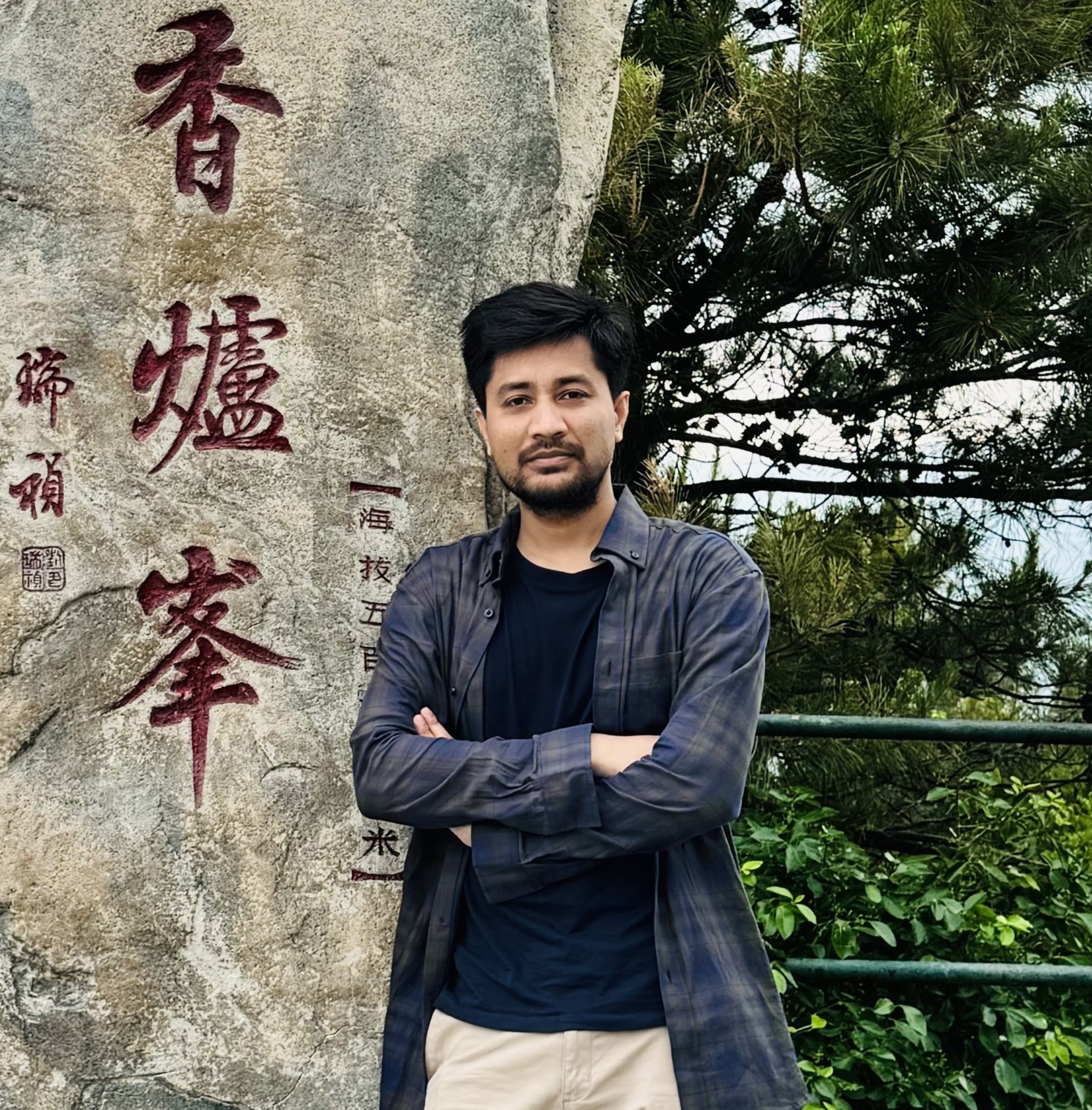
Research-focused AI specialist with expertise in computer vision and multimodal intelligence, bridging theoretical innovation with practical solutions.
I received my Master's in Computer Science from Beijing Institute of Technology and Bachelor's degree from Chongqing University of Science and Technology in the field of Computer Science. My research focuses on artificial intelligence, machine learning applications, computer vision, remote sensing, big data analysis, and multimodal intelligence. My work spans publications in venues like EMNLP and journals such as Cyber Security and Applications, where I've contributed to advancements in multimodal intelligence and intrusion detection systems. With experience as a Project Supervisor at the Consortium Research Center and as an Assistant Software Developer, I bridge theoretical innovation with practical implementation.
An Intelligent Search Engine Module for Academic Networks designed to index academic content and support efficient retrieval for research networks.
In-Depth Study of Tiny Object Detection Using Deep Learning. Investigated methods for detecting small objects in complex scenes using multi-scale feature fusion.
Built classifiers to detect anomalous network patterns using statistical and machine learning techniques. Improved detection recall through feature engineering.
Collected and preprocessed housing data to train regression models for predicting rent prices in Dhaka. Evaluated feature importance and provided actionable insights.
Developed an image content review system based on deep learning object identification. Identifies unwanted images from real-time videos using object detection.
Developed a machine learning system to identify fraudulent transactions by applying classification algorithms and feature engineering techniques.
Developed Spring-based Web Applications, SpringBoot, and Spring MVC projects for enterprise use cases and academic demonstrations.
In the age of rapid digital communication, social media has become a leading platform for consuming and sharing information. This transformation has also made it easier for rumors and false narratives to spread rapidly, often reaching large audiences within hours.
Unlike earlier forms of disinformation that were primarily text-based, modern rumors often combine both text and images to construct compelling but deceptive stories. Detecting such multimodal rumors presents new challenges, as it requires understanding not just each piece of content in isolation, but how they work together to mislead. Traditional rumor detection models aim to identify such content by relying on textual cues or employing shallow multimodal fusion techniques to align modalities of information. However, these approaches often struggle to capture the complex semantic interplay between modalities, especially when faced with semantic discrepancies or emotionally enforced visual cues. This is due to their inability to effectively model the subtle semantic variation, hierarchical, and non-linear relationships that exist between different modalities. Despite recent advances, existing rumor detection models face two critical challenges: (1) Existing methods often treat semantic discrepancies or ambiguities as noise during the fusion of visual and textual modalities. This neglect causes the models to overlook essential cross-modal interdependencies, ultimately leading to poor performance. (2) Most approaches assume a one-to-one correspondence between visual and linguistic features, ignoring the richer hierarchical relationships that bridge different semantic levels across modalities. As a result, models often fail to capture the layered structure of meaning and overlook important hierarchical cues. To address these challenges, this study presents the following key contributions: (1) The study introduces RADAR, a framework that treats semantic discrepancies not as noise to be reduced or ignored, but as valuable signals that can enhance detection. RADAR focuses on amplifying them by incorporating three modules: First, the Semantic Discrepancy Amplifier (SDA), a multi-head attention mechanism that dynamically detects and amplifies mismatches between modalities. Second, these differences are improved using Progressive Feature Purification (PFP), which adjusts filters to remove unnecessary noise while keeping important signals. Third, the Feature Feedback Loop (FFL) continuously improves the quality of the features. Together, these components form a pipeline that effectively highlights subtle inconsistencies often found in rumor content. RADAR achieves state-of-the-art results, with 96.0\% accuracy on the Twitter dataset and 91.2\% on Weibo, effectively detecting both rumors and non-rumors by amplifying semantic discrepancies. (2) This paper proposes the RumorCone framework that incorporates semantic hierarchies using hyperbolic geometry to preserve hierarchical, non-linear relationships, rather than representing them at a flat semantic level. It decomposes both image and text content into three levels: base, mid, and high-level abstractions. First, it places these different types of information into a hyperbolic space to preserve their natural tree-like shape and show how they interact non-linearly. Second, the model uses cross-modal hyperbolic attention, which focuses on important features from each modality at every level while maintaining consistency across modalities. Additionally, hierarchical semantic processing ensures that text and image features are aligned at each level of abstraction, further enhancing the model's ability to identify misalignments. Third, it uses a flexible fusion method that dynamically adjusts the contribution of each modality based on its alignment. RumorCone achieved improved performance 86.76\% F1-score on MR²-E and 85.48\% on MR²-C by utilizing hierarchical reasoning in hyperbolic space. The study further evaluates through cross-lingual experiments, gathering 100 recent social media posts in five languages and including various scenarios across multiple platforms. It achieved 83\% accuracy on high-resource languages such as English and Chinese; performance declines to 68\% for Bengali and Hindi due to translation-induced semantic shifts, with baselines performing even worse. The research demonstrated that semantic discrepancies serve as significant indicators of rumor content, while hierarchical semantic reasoning enhances the accuracy of content-based detection. Cross-lingual evaluation revealed the necessity for datasets covering low-resource languages.

The rise of multimodal content on social platforms has led to the rapid spread of complex and persuasive false narratives, combining of text and images.
Traditional rumor detection models attempt to identify such content by relying on textual cues or employing shallow multimodal fusion techniques. However, these methods often assume a simplistic one-to-one alignment between modalities, overlooking the richer hierarchical relationships across modalities, failing to capture the layered structure of meaning. In this paper, we present RumorCone, a novel method that employs hyperbolic geometry in order to preserve hierarchical, non-linear relationships, rather than representing them at a flat semantic level. First, RumorCone decomposes image and text content into three levels: base, mid, and high-level abstractions, and embeds them in hyperbolic space to model their tree-like semantic structure. Second, a dynamic hyperbolic multimodal attention mechanism aligns features across modalities and levels, and a flexible fusion strategy adjusts the contribution of each modality based on alignment quality. Our experiments indicate the importance of hierarchical semantic modeling for robust and interpretable multimodal rumor detection.
The proliferation of IoT devices and their reliance on Wi-Fi networks have introduced significant security vulnerabilities, particularly the KRACK and Kr00k attacks, which exploit weaknesses in WPA2 encryption to intercept and manipulate sensitive data.
Traditional intrusion detection systems (IDS) using classifiers face challenges such as model overfitting, incomplete feature extraction, andhighfalse positive rates, limiting their effectiveness in real-world deployments. Toaddress these challenges, this study proposes a robust multiclass machine learn ing based intrusion detection framework. The methodology integrates advanced feature selection techniques to identify critical attributes, mitigating redundancy and enhancing detection accuracy. Two distinct ML architectures are imple mented: a baseline classifier pipeline and a stacked ensemble model combining noise injection, Principal Component Analysis (PCA), and meta learning to im prove generalization and reduce false positives. Evaluated on the AWID3 dataset, the proposed ensemble architecture achieves superior performance, with an ac curacy of 98%, precision of 98%, recall of 98%, and a false positive rate of just 2%, outperforming existing state-of-the-art methods. This work demonstrates the efficacy of combining preprocessing strategies with ensemble learning to fortify network security against sophisticated Wi-Fi attacks, offering a scalable and reli able solution for IoTenvironments. Futuredirectionsincludereal-timedeployment and adversarial resilience testing to further enhance the model’s adaptability.
Represented international students within the CST department; organized activities and supported departmental coordination to improve international-student experience and orientation.
Contributed to cultural events and university activities; supported the international affairs office in organizing and running successful cross-cultural programs and events.
Worked as a volunteer to assist international student admissions and registration processes during the summer intake at BIT, helping new students with onboarding and registration.
Supervising ongoing research under Project 104 at CRC, focusing on multimodal intelligence, rumor detection, and uncertainty propagation in social media data. Guiding junior researchers in model development, experimental design, and publication strategies.
Provided a presentation in introduction to Machine Learning and Knowledge Discovery class focused on Introduction to ML & DL.
Literature Review, Experimental Design, Data Preprocessing, Model Evaluation, Academic Writing, Presentation
I can quickly absorb and integrate knowledge across Programming, Data Science, and Web Development. My experience includes Python, C++, Java, and frameworks like Django and Flask. I am skilled in model development, data analysis, and machine learning with tools such as Pandas, NumPy, and TensorFlow. I am also comfortable with DevOps tools like Git, Docker, and collaborative research workflows.
View My ProjectsSpringer Nature; Wiley
Served as a peer reviewer, contributing scholarly reviews for manuscript submissions to Scientific Reports and the International Journal of Communication Systems.
View DocumentationBeijing Institute of Technology
Recognized for outstanding academic performance and contributions during the Master's program at BIT.
View CertificateUniversity of Science and Technology Beijing
Achieved second place in an international robotics competition showcasing innovation and technical excellence.
View CertificateChongqing University of Science & Technology
Recognized for excellence in academic achievement and contributions to the university community.
View CertificateChongqing University of Science & Technology
Awarded for active participation and contribution to cultural and artistic programs, promoting cross-cultural collaboration and student engagement.
View CertificateChongqing University Students Competitions
Winner of the Nader Cup for three consecutive years in university-level English writing competitions.
View Certificatedeeplearning.ai
Completed comprehensive training in TensorFlow for building AI and machine learning solutions.
Verify CertificateJohns Hopkins University
Completed training in statistical methods and applications for data analysis.
Verify Certificatedeeplearning.ai
Completed training in neural network architectures and deep learning implementation.
Verify CertificateYONSEI University
Completed training in emerging technologies for big data analysis and applications.
Verify CertificateYONSEI University
Completed training in data visualization techniques using Tableau.
Verify CertificateJohns Hopkins University
Completed training in R programming language for statistical computing and graphics.
Verify CertificateIBM
Completed training in artificial intelligence applications using IBM Watson.
Verify Certificate
Associate Professor
School of Intelligent Technology & Engineering
Chongqing University of Science & Technology
Reference letter available upon request.
Associate Professor (Supervisor)
School of Computer Science and Technology
Beijing Institute of Technology
Reference letter available upon request.
Teacher (Supervisor)
School of Intelligent Technology & Engineering
Chongqing University of Science & Technology
Reference letter available upon request.
If you have any questions or queries about me, Feel free to contact me by telephone or email and I will sure to get back to you as soon as possible.